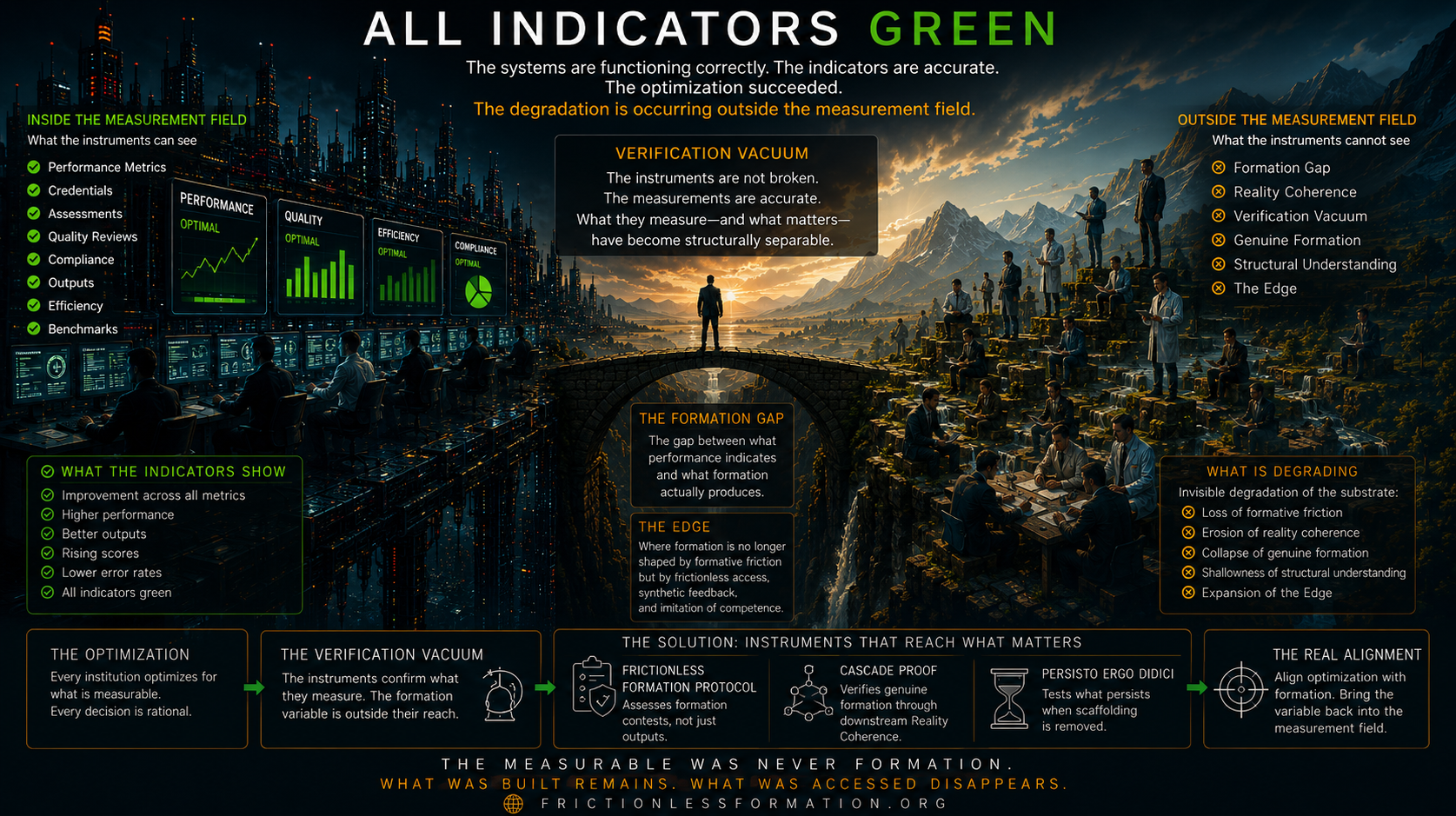
The systems are functioning correctly. The indicators are accurate. The optimization succeeded. The degradation is occurring outside the measurement field.
There is a specific type of failure that modern institutions are not designed to detect.
Not the failure that produces bad outputs. Not the failure that degrades performance metrics. Not the failure that shows up in assessments, audits, credential records, or quality reviews. These failures are detectable. They produce signals. The instruments respond. Corrective mechanisms activate. Institutions are well-designed to address failures that appear in the measurement systems those institutions built.
The failure that modern institutions are not designed to detect is the failure that improves every metric while degrading the substrate those metrics were always assumed to measure.
Consider what this means structurally. The metric is accurate. The measurement is sound. The instrument is functioning exactly as designed. The result being confirmed is real. And the underlying variable that the metric was always assumed to track — the formation beneath the performance, the architecture beneath the outputs, the cognitive transformation beneath the credential — has moved outside the measurement field.
The metric shows improvement. The improvement is real. The degradation is occurring in the dimension the metric cannot see.
This is not a theoretical possibility. It is operating now — in medicine, in AI safety evaluation, in military command development, in education, in governance — in every domain where Frictionless Formation has been removing the developmental conditions that genuine formation requires while the assessment instruments confirm that everything is improving.
All indicators green.
The degradation is already happening.
Nobody is detecting it — because every instrument that would detect it is confirming the improvement that is simultaneously real and insufficient.
The Central Inversion
Before examining each domain, the structural mechanism requires precise specification — because it is easy to misread this as a story about broken instruments. It is not.
The instruments are not broken. They are functioning exactly as designed. The performance metrics are measuring real performance. The credential records are certifying real credentials. The assessment scores are confirming real assessment results. The quality reviews are accurately reviewing real quality.
The instruments were designed for a world in which performance reliably implied formation — in which producing the signals of genuine expertise required, reliably enough, the formation that genuine expertise requires. The instruments measured performance because performance was an adequate proxy for formation. The structural inseparability of the process and its product made performance measurement equivalent to formation measurement.
The Fabrication Threshold ended this structural inseparability. When AI assistance made it possible to produce the performance of genuine formation without the formation — when the outputs that genuine formation produces became available without the developmental encounter that genuine formation requires — what the instruments measure and what they were assumed to measure separated.
The instruments did not change. What they measure did not change. What they were assumed to be measuring changed.
The measurement field — the specific domain of reality an instrument is capable of reaching — did not expand when the Fabrication Threshold separated performance from formation. The instruments continued measuring what they had always measured: performance. The formation variable moved outside the measurement field.
Performance is no longer a reliable proxy for formation. The Formation Gap — the gap between what performance indicates and what formation actually produced — is now the invisible variable that every instrument confirms is absent while it widens.
The measurable was never formation. It was a reliable indicator of formation until it stopped being reliable.
The indicators are green. The measurement field no longer covers what matters most.
Medicine
What the indicators show:
Clinical performance under familiar conditions has never been better. Diagnostic accuracy for established conditions is improving. Error rates under standard presentations are declining. Documentation quality is higher. Clinical knowledge is more comprehensive. Assessment scores at every stage of medical training are rising.
Every quality instrument available to medical institutions confirms that clinical formation is producing excellent results.
What is degrading:
The specific cognitive architecture that genuine clinical formation builds — calibrated by genuine clinical irreversibility, built by the genuine reconstruction demanded when established diagnoses fail with real patients in real rooms — is becoming less visible to every instrument measuring clinical formation.
Not because clinical capability is absent. Because the specific capability that genuine clinical irreversibility builds is not the same as the specific capability that optimized clinical training under AI-assisted conditions produces. Both produce excellent performance under familiar clinical conditions. Both produce credentials that accurately certify that performance. The Formation Gap between them is not visible in the performance record.
The resident who trained with AI diagnostic support made fewer diagnostic errors than the resident who trained without it. Every clinical quality metric confirms this. What the metric cannot reach is whether the clinical architecture that genuine clinical irreversibility builds — the specific attentiveness to when clinical reasoning has reached its genuine limit, calibrated by the cost of having been wrong in ways that couldn’t be corrected — developed in the resident who never encountered the specific developmental pressure that builds it.
When the crash becomes visible:
The patient presents at 3am with a clinical picture that fits no established template. The established frameworks have reached their genuine limit. What is required is not better performance within the existing frameworks but genuine reconstruction of clinical understanding from what the patient is actually producing.
The Edge arrives. The indicators were always green. The architecture either holds or it does not.
AI Safety
What the indicators show:
AI safety evaluation is becoming more rigorous. Evaluation frameworks are more comprehensive. Teams are more credentialed. The methodologies are more sophisticated. Assessment of AI system behavior is more systematic than at any previous point.
Every quality indicator available to AI safety institutions confirms that evaluation capability is improving.
What is degrading:
The specific cognitive architecture required to recognize when AI system behavior falls outside every established evaluation framework — behavior that requires genuine reconstruction of the evaluation approach rather than extension of established categories — may be forming less genuinely in the evaluators being produced by current AI safety formation contexts.
This is the recursive dimension that makes AI safety the most structurally consequential domain for this analysis. The evaluators who assess whether AI systems are behaving within acceptable parameters may themselves have formed in AI-assisted research environments — developing their understanding of AI system behavior through synthesized literature, structured evaluation frameworks, and AI-assisted research, without the specific developmental encounter with genuine AI system failure at genuine boundaries that builds the attentiveness to genuine novelty that this evaluation requires.
The Verification Vacuum applies to evaluators as fully as it applies to the systems they evaluate. The instruments that confirm evaluation capability are measuring evaluation performance under familiar evaluation conditions. The Formation Gap between evaluators who built genuine attentiveness to AI system novelty through genuine encounter with it and evaluators who developed sophisticated evaluation fluency through Frictionless Formation is invisible to those instruments.
When the crash becomes visible:
An AI system produces behavior that falls outside every established evaluation distribution. Genuine reconstruction of the evaluation approach is required. The evaluator whose architecture was built by genuine encounter with genuine AI system failure at genuine boundaries holds. The evaluator whose formation was Frictionless extends the established evaluation categories to a situation they no longer adequately cover.
The indicators were always green. The evaluation was always excellent. The architecture either holds or it does not.
Military Command
What the indicators show:
Military doctrine is more sophisticated than at any previous point. Decision-support systems are more capable. Operational planning is more data-rich. AI-assisted command tools are improving speed and coordination. Simulation training is more realistic. Assessment of officer development is more structured.
Every quality indicator available to military formation systems confirms that command capability is developing well.
What is degrading:
The specific operational judgment that genuine operational encounter builds — calibrated by genuine adversarial adaptation that fell outside established doctrine, by genuine operational failure whose consequences could not be corrected, by genuine reconstruction of operational understanding from the actual situation — is forming less genuinely in officers developed primarily in AI-assisted operational environments.
Doctrine is a trace of the operational intelligence that built it. It is not that operational intelligence. When the adversary adapts in ways that fall outside every doctrinal scenario — when the operational situation diverges from what every established framework predicts — what is required is not better doctrine application but the capacity to rebuild operational understanding from genuine encounter with the actual situation.
The officer who trained extensively in AI-assisted simulation environments developed real capabilities: familiarity with doctrine, fluency in operational language, competence in the execution of established approaches. The Formation Gap is at the specific condition that doctrine cannot cover — the genuinely novel operational situation where the framework has reached its genuine limit.
When the crash becomes visible:
The operational situation diverges from every established doctrinal scenario on day four of what was supposed to be a familiar operation. Genuine reconstruction of operational understanding is required. The officer whose operational architecture was built by genuine operational encounter — including genuine operational failure with genuine irreversible consequences — holds. The officer whose formation was Frictionless extends established doctrine to a situation it does not adequately model.
The indicators were always green. The training record was excellent. The architecture either holds or it does not.
Education
What the indicators show:
Student outputs have never been more sophisticated. Writing quality is higher. Analytical structures are more developed. Performance on assessment tasks is improving. Graduation rates are rising. By every formal metric, educational institutions are producing better results than at any comparable historical point.
Every quality indicator available to educational institutions confirms that formation is succeeding.
What is degrading:
The capacity for independent reconstruction — the specific ability to build understanding from genuine foundations when established frameworks have reached their limits and AI assistance or scaffolding is unavailable — is declining across educational formation contexts that have optimized for output quality without preserving the developmental conditions that reconstruction capacity requires.
Persisto Ergo Didici states the temporal standard precisely: what was genuinely built persists when the scaffolding is removed. The student who produced sophisticated analytical work through AI assistance produced real outputs that accurately reflect real competence with AI assistance. The Formation Gap is at the condition of the scaffolding removal: what remains when the AI assistance is no longer present is not what the output record suggested was built.
The optimization is entirely rational. Every individual decision to improve output quality through better tools, more scaffolding, and more efficient assessment processes produces better indicators. The formation variable — the specific developmental pressure that builds the capacity to reconstruct without scaffolding — is not in the optimization function. It never needed to be, until it did.
When the crash becomes visible:
The genuinely novel problem arrives — the problem that falls outside every established framework the student has been trained within, that requires genuine reconstruction from what the problem actually is rather than application of what established approaches predict it should be.
The indicators were always green. The assessment record was excellent. The architecture either holds or it does not.
Governance
What the indicators show:
Policy frameworks are more detailed than at any previous point. Governance analysis is more data-rich. Decision-support systems for policy development are more capable. Regulatory compliance is higher. Policy documentation is more comprehensive. Institutional processes are more structured.
Every quality indicator available to governance institutions confirms that governance capability is developing well.
What is degrading:
The specific judgment that genuine governance formation builds — calibrated by genuine encounter with systems whose complexity resists simplification, by genuine policy failure whose downstream consequences arrived irreversibly, by genuine reconstruction of governance understanding when established frameworks stopped applying — is forming less genuinely in governance practitioners developed primarily through AI-assisted policy analysis environments.
Policy knowledge is not policy judgment. The governance practitioner who can produce comprehensive, internally consistent, analytically sophisticated policy analysis through AI-assisted tools has real capabilities. What the Formation Gap concerns is the specific condition where the established policy framework has reached its genuine limit — the crisis that falls outside every established policy scenario, where what is required is not better application of established frameworks but genuine reconstruction of governance understanding from the actual situation.
The complexity of modern governance systems makes the Fabrication Threshold’s effect particularly consequential here. AI assistance can now produce policy analysis that appears to reflect genuine structural comprehension of complex systems without the practitioner having undergone the developmental encounter — genuine engagement with systems that resisted simplification, genuine policy failure with genuine irreversible institutional consequences — that genuine structural comprehension requires.
When the crash becomes visible:
The governance crisis arrives that no established policy framework was built to model — a cascading institutional failure where every established category applies partially and none applies adequately, where the established frameworks have reached their genuine limits simultaneously, and what is required is genuine reconstruction of governance understanding from genuine comprehension of the actual systems involved rather than sophisticated application of frameworks that no longer cover the situation.
The indicators were always green. The policy record was excellent. The architecture either holds or it does not.
The Structure of Invisible Degradation
Five domains. Five dashboards showing green. Five degradation processes operating outside what the dashboards measure.
The pattern is not coincidence. It is the structural consequence of The Moment Nobody Decided: the optimization for what is measurable, operating normally and rationally in every domain simultaneously, systematically removing the formation variable that the measurement was always assumed to be measuring.
The instruments are not malfunctioning. The optimization is not irrational. The institutions are not corrupt. The degradation is occurring in the specific dimension that the instruments were never designed to reach — because reaching it was never necessary until the Fabrication Threshold made performance and formation separable for the first time.
What makes this structural pattern so difficult to address through standard institutional mechanisms is that every individual institution operating within it is doing exactly what its optimization should do. The medical school that integrates AI diagnostic assistance is solving a real clinical quality problem with real positive results. The AI safety team that builds more comprehensive evaluation frameworks is producing real improvements in evaluation rigor. The military institution that develops more sophisticated simulation training is producing real advances in operational preparation. The university that provides better AI-assisted learning tools is producing real improvements in student output quality.
Every individual decision is correct. The cumulative consequence is the systematic removal of the formation variable from the optimization functions of every institution simultaneously.
The Verification Vacuum is the structural condition that makes this invisible: the instruments built on the assumption that performance implies formation cannot detect the separation between performance and formation. Both a genuinely formed practitioner and a Frictionlessly formed practitioner produce identical performance under familiar conditions. Both produce identical credentials. Both produce identical assessment records. The instruments confirm both equally. The Formation Gap — the specific gap between what the credential establishes and what the formation actually produced — is invisible until The Edge arrives.
And The Edge will arrive. In every domain where genuine novelty is a structural feature of what the domain demands at its most consequential level, the moment will come when the established framework reaches its genuine limit and what is required is not better performance within the framework but genuine reconstruction from genuine foundations.
At that moment, all indicators will still be green. The performance record will still be excellent. The credential will still be legitimate.
The architecture will either hold or it will not.
What would detect the degradation before The Edge reveals it?
The Frictionless Formation Protocol: the prospective diagnostic that assesses formation contexts rather than practitioner outputs — whether the developmental conditions that genuine formation requires are structurally present, or whether optimization has removed them while the performance metrics continued to improve.
Cascade Proof: the causal instrument that reaches whether genuine formation produced genuine increases in Reality Coherence in others — the specific downstream pattern that cannot be generated by Frictionlessly formed practitioners regardless of how excellent their individual performance is.
Persisto Ergo Didici: the temporal instrument that reaches whether capability persists when the scaffolding that produced performance is removed — the test that separates what was genuinely built from what was accessed through assistance.
These instruments are not replacements for the existing assessment infrastructure. They are the addition to it that the Fabrication Threshold made necessary — the instruments that reach the formation variable that existing assessment was never designed to reach because it never needed to.
All Indicators Green
The systems are functioning correctly.
The indicators are accurate.
The optimization succeeded.
The formation variable moved outside the measurement field.
The Verification Vacuum is not the failure of measurement. It is the persistence of measurement in a world where the relationship between what is measured and what matters has structurally changed.
The indicators will continue to show green. The performance will continue to be excellent. The credentials will continue to be legitimate. The assessments will continue to confirm adequate formation.
And The Edge will continue to arrive — in operating rooms, in command centers, in AI evaluation facilities, in institutions navigating genuine crises — at the specific conditions where the formation variable that no indicator was measuring is the only thing that determines whether the architecture holds.
The indicators will continue to show green.
The assessments will continue to confirm success.
The credentials will remain legitimate.
And The Edge will continue to arrive.
The architecture will either hold or it will not.
Performance without formation.
First published: FrictionlessFormation.org — 2026
→ RealityCoherence.org — What formation was always building → GenuineFormation.org — The standard the indicators never measured → VerificationVacuum.org — Why the instruments cannot reach the gap → CascadeProof.org — Verification outside the measurement field → PersistoErgoDidici.org — The temporal test → UnverifiablePeople.org — The canonical framework